




Albero Academy

PGP in Data Science & AI Engineering

Build, deploy & operate production AI, from ML to LLMs and MLOps

  • Master ML, Deep Learning, LLMs & Generative AI end-to-end
  • Build & deploy RAG and agentic LLM apps with LangChain
  • Production MLOps: containerize, serve & monitor real models
  • Mentorship from Data Scientists at Microsoft, Amazon & Google
Fees and EMI
Most Popular
Duration
9 Months
Next batch
5 Dec 2026
A new batch starts in every program, every month.
Format
Live + Capstone
Level
Intermediate
Reserve with
₹5,000
Non-refundable · counts towards your fee
Full fee
₹95,000

A 9-month advanced specialization for learners ready to become Data Scientists and AI/GenAI Engineers. Go from Machine Learning and Deep Learning to LLMs, LangChain, RAG and MLOps — shipping production-grade AI products with mentorship from engineers at Microsoft and Amazon.

Next batch: 5 Dec 2026

Talk to a counsellor

Quick 15-min call: get program details, eligibility, and fee structure.

  1. About you
  2. Your goal
  3. Talk to us

Step 1 of 3: About you

We don’t spam

By submitting this form, you agree to the T&C and Privacy Policy

Duration
9 Mo
Live Sessions
90+
Industry Projects
15+
AI Lab Access
100%

Our graduates now build at India’s top companies.

Every logo represents a real placement, not a paid sponsorship. Our alumni are powering AI, data, and analytics teams at companies you already admire.

Hiring partners
650+
Avg salary growth
3.1×
Placed within 90 days
94%
Median offer (top quartile)
₹18 LPA
GoogleBig Tech
AmazonBig Tech
RazorpayFintech
PhonePeFintech
ZomatoConsumer
Walmart LabsBig Tech
IBMBig Tech
EYConsulting
TCSServices
WiproServices
KPMGConsulting
Learners
6,000+
Placement rate
98%
Average salary growth
280%
Hiring partners
650+

A future-proof path to becoming a Data Scientist / AI Engineer

AI has moved from research novelty to core business infrastructure. The market no longer hires people who “know machine learning”; it hires engineers who can ship AI systems (ML + LLMs + RAG) into production. India has one of the largest demand-vs-supply gaps for this exact skillset.

Fastest-growing job title since 2023 (AI Engineer)
#1
Salary range (global/remote upside higher)
₹8–30 LPA+
Industry projects built
40+

Who it’s for

  • Graduates with basic coding
  • Analysts levelling up
  • Software engineers pivoting to AI
  • Strong quantitative aptitude

Real learners. Real career transformations.

From fresh graduates to working professionals, our learners have moved into high-paying roles at top companies through structured mentorship, real projects and placement-driven training.

Albero Academy learnerYour story could be next.See every learner story

The Albero advantage.

What you actually get when you sign up, beyond the lecture videos.

  1. 01

    Mentor-led, not video-only

    1:1 reviews + weekly group sessions with practitioners hiring at MAANG.

    Mentor-led, not video-only
  2. 02

    Portfolio-grade projects

    Build the exact deliverables hiring managers ask about in interviews.

    Portfolio-grade projects
  3. 03

    Placement & salary support

    Mock interviews, resume + LinkedIn craft, direct referrals to 650+ partners.

    Placement & salary support

What you’ll actually learn.

Tools, concepts, and the soft skills that round out the package.

  • 01PythonPython
  • 02NumPyNumPy
  • 03pandaspandas
  • 04scikit-learnscikit-learn
  • 05PyTorchPyTorch
  • 06TensorFlowTensorFlow
  • 07JupyterJupyter
  • 08Hugging FaceHugging Face
  • 09OpenAIOpenAI
  • 10LangChainLangChain
  • 11MLflowMLflow
  • 12Weights & BiasesWeights & Biases
  • 13DockerDocker
  • 14StreamlitStreamlit

14 tools you’ll touch, and many more reviewed in 1:1 mentor sessions.

Build skills that top companies hire for.

Master AI, Data Science, Full Stack Development, CyberSecurity, Data Engineering, and Finance through live mentor-led programs designed around real industry expectations and high-growth career outcomes.

PGP

Your stack

  • Python
  • PyTorch
  • TensorFlow
  • LangChain
  • OpenAI

5 tools, one cohesive lab

  • Industry-Aligned Learning

    Train on modern tools, workflows, and technologies inspired by the ecosystems used at Microsoft, IBM, Cisco, J.P. Morgan, and other global leaders.

  • Real Projects. Real Experience.

    Build portfolio-grade projects, solve practical business problems, and gain hands-on exposure that prepares you for actual interviews and job environments.

  • Career Acceleration Support

    Get dedicated mentorship, resume building, mock interviews, placement assistance, and career guidance designed to help you secure high-paying opportunities.

14+ industry tools, woven into every lab.

Train with industry-grade technologies, build real-world projects, and gain hands-on experience through mentor-led programs designed around modern hiring standards.14 industry-grade tools powering real-world career outcomes

Python
pandas
PyTorch
Jupyter
OpenAI
MLflow
Docker

Industry projects.

Capstones built on real datasets and real briefs, graded on craft, not completion.

GenAI customer support agent
Generative AISaaS support10K-document knowledge base

GenAI customer support agent

A retrieval-augmented agent that answers customer tickets from product docs, escalates when unsure, and logs every answer for review.

  • PythonPython
  • LangChainLangChain
  • OpenAIOpenAI
  • FastAPIFastAPI
78% tickets auto-resolved on the eval set3 weeks

Image classification at scale
MLRetailcustom SKU catalogue

Image classification at scale

Fine-tune a CNN on a client SKU dataset and ship it behind a real-time endpoint with latency budgets.

  • PyTorchPyTorch
  • AWSAWS
  • DockerDocker
94% top-1 at <120 ms p952 weeks
Demand forecasting
MLLogistics3 years of shipments

Demand forecasting

Time-series forecasting for a logistics provider with explainable feature importances the ops team can trust.

  • PythonPython
  • scikit-learnscikit-learn
  • pandaspandas
MAPE cut from 21% to 9%2 weeks
Credit-risk scorecard
MLNBFC300K loan applications

Credit-risk scorecard

An explainable default-risk model with SHAP attributions, fairness checks and a monitoring plan for drift.

  • scikit-learnscikit-learn
  • MLflowMLflow
  • JupyterJupyter
AUC 0.84 with per-decision explanations2 weeks
Recommendation engine
MLOTT streamingclickstream

Recommendation engine

Two-tower recommender trained on watch history, served with an A/B harness to measure lift against the incumbent.

  • PyTorchPyTorch
  • pandaspandas
  • FastAPIFastAPI
+12% click-through in offline replay3 weeks
LLM fine-tune & eval harness
Generative AIDomain-tune an open model for legal summaries

LLM fine-tune & eval harness

LoRA fine-tune an open model on domain data, then build the evaluation suite that proves it beats the base model.

  • Hugging FaceHugging Face
  • PyTorchPyTorch
  • Weights & BiasesWeights & Biases
Eval win-rate 71% vs base3 weeks

Case studies you’ll work on.

Same problems hiring managers ask about in interviews. We walk every step with you.

Adobe case study
Adobe

Adobe

Big Tech

Outcome

92% auto-cleared

  1. Problem

    Image moderation queue grew 3× without proportionate headcount.

  2. Approach

    Fine-tuned a CLIP variant on labelled data + active-learning loop.

  3. Result

    Human reviewers focus only on the residual 8%.

See full case study
Netflix case study
Netflix

Netflix

Big Tech

Outcome

+11% watch-time

  1. Problem

    Recommendation CTR plateaued; cold-start cost watch-time per session.

  2. Approach

    Two-tower retrieval + diversity re-ranker, trained on dwell signals not clicks.

  3. Result

    Per session, holding catalogue + thumbnail strategy constant.

See full case study

Curriculum, module by module.

Industry-validated, practice-first, mentor-reviewed every batch.

modules
8
weeks
39
topics
62
module projects
8
  1. The maths behind every model, taught through code. Enough linear algebra and probability to read a paper and debug a model — no more.

    What you’ll cover

    1. 01

      Python for data science

      comprehensions, functions, classes and writing clean, testable code

    2. 02

      NumPy

      arrays, broadcasting and vectorisation that is 100× faster than loops

    3. 03

      pandas at scale

      joins, groupby, time series and memory-efficient dtypes on 1M+ rows

    4. 04

      Linear algebra

      vectors, matrices, dot products, projections and eigen-intuition for ML

    5. 05

      Calculus for ML

      derivatives, the chain rule and gradients as the engine of learning

    6. 06

      Probability

      random variables, distributions, Bayes’ theorem and expectation

    7. 07

      Statistics

      sampling, confidence intervals, hypothesis tests and the p-value done right

    8. 08

      Exploratory data analysis

      profiling, visualising and finding the story before modelling

    Tools you’ll use

    • PythonPython
    • NumPyNumPy
    • pandaspandas
    • JupyterJupyter

    AI in this module

    Use ChatGPT as a maths tutor to re-explain a derivation, then confirm your understanding by implementing it in NumPy.

    Module project

    Exploratory analysis of a 1M-row fintech dataset

    You’ll be able to

    • Vectorised NumPy and pandas
    • Matrix intuition for ML
    • Distributions, sampling and hypothesis tests
  2. Classical ML end-to-end: from a baseline to a tuned ensemble, with the evaluation discipline that separates data scientists from notebook hobbyists.

    What you’ll cover

    1. 01

      The ML workflow

      problem framing, train/validation/test splits and leakage to avoid

    2. 02

      Linear & logistic regression

      assumptions, regularisation (L1/L2) and interpreting coefficients

    3. 03

      Tree-based models

      decision trees, random forests and why they overfit

    4. 04

      Gradient boosting

      XGBoost and LightGBM, the workhorses of tabular ML

    5. 05

      Unsupervised learning

      k-means, hierarchical clustering and PCA for structure in data

    6. 06

      Feature engineering

      encoding, scaling, interactions and pipelines with scikit-learn

    7. 07

      Evaluation

      precision/recall, ROC-AUC, calibration and choosing the metric the business needs

    8. 08

      Explainability

      SHAP and permutation importance for models a risk team will sign off

    Tools you’ll use

    • scikit-learnscikit-learn
    • pandaspandas
    • JupyterJupyter

    AI in this module

    Have an LLM review your pipeline for data leakage and propose features, then accept only what improves validated scores.

    Module project

    Credit-risk model with an explainability report

    You’ll be able to

    • Train regression and classification models
    • Tune gradient-boosted ensembles
    • Choose the right metric and validate honestly
  3. How neural networks learn, from a perceptron to the transformer that powers every LLM. Built from scratch first, then with frameworks.

    What you’ll cover

    1. 01

      Neural networks from scratch

      neurons, activations and a forward pass in NumPy

    2. 02

      Backpropagation

      computing gradients by hand, then trusting autograd

    3. 03

      Optimisation

      SGD, momentum, Adam, learning-rate schedules and batch size

    4. 04

      Regularisation

      dropout, weight decay, batch norm and early stopping

    5. 05

      CNNs for vision

      convolutions, pooling, ResNet-style architectures

    6. 06

      Sequence models

      RNNs, LSTMs and why they gave way to attention

    7. 07

      Attention & transformers

      self-attention, positional encoding and the transformer block

    8. 08

      Transfer learning

      reusing pretrained models when you have little labelled data

    Tools you’ll use

    • PyTorchPyTorch
    • NumPyNumPy
    • JupyterJupyter

    AI in this module

    Use AI coding assistants to scaffold architectures, while you write the training loop and debug the shapes yourself.

    Module project

    Image classifier from scratch, then transfer-learned

    You’ll be able to

    • Backprop and optimisation intuition
    • CNNs for vision, RNNs for sequences
    • Attention and the transformer block
  4. Production training loops, data pipelines and GPU acceleration in the two frameworks every ML job posting asks for.

    What you’ll cover

    1. 01

      PyTorch fundamentals

      tensors, autograd, nn.Module and the canonical training loop

    2. 02

      TensorFlow & Keras

      the functional API, callbacks and tf.data pipelines

    3. 03

      Data loading

      Datasets, DataLoaders, augmentation and avoiding the input bottleneck

    4. 04

      Custom training loops

      mixed precision, gradient accumulation and checkpointing

    5. 05

      GPU acceleration

      CUDA basics, profiling and multi-GPU training with DDP

    6. 06

      Experiment tracking

      logging runs, metrics and artefacts in Weights & Biases

    7. 07

      Model export

      TorchScript, ONNX and SavedModel for serving

    Tools you’ll use

    • PyTorchPyTorch
    • TensorFlowTensorFlow
    • Weights & BiasesWeights & Biases

    AI in this module

    Use Copilot to convert a model between PyTorch and Keras, then verify both give the same outputs on the same batch.

    Module project

    Fine-tuned vision transformer trained on GPU

    You’ll be able to

    • Write custom training loops
    • Build efficient data loaders
    • Profile and accelerate on GPU
  5. Work with large language models as an engineer: prompt systematically, fine-tune open models, and evaluate outputs with rigour.

    What you’ll cover

    1. 01

      How LLMs are built

      pretraining, instruction tuning and RLHF in plain terms

    2. 02

      Tokenisation & context

      tokens, context windows, cost and latency trade-offs

    3. 03

      Prompt engineering

      zero/few-shot, chain-of-thought and structured JSON outputs

    4. 04

      Function calling & tools

      letting a model call your APIs safely

    5. 05

      Open models

      running Llama-class models with Hugging Face Transformers

    6. 06

      Fine-tuning

      LoRA and QLoRA on a single GPU, and when fine-tuning beats prompting

    7. 07

      Evaluation

      golden datasets, LLM-as-judge and regression tests for prompts

    8. 08

      Safety

      hallucination, bias and content filtering in production

    Tools you’ll use

    • OpenAIOpenAI
    • Hugging FaceHugging Face
    • PyTorchPyTorch
    • PythonPython

    AI in this module

    The core of the module: build with the OpenAI API and open models, and measure every change with an evaluation set.

    Module project

    Domain fine-tune of an open model with an eval harness

    You’ll be able to

    • Structured prompting and function calling
    • LoRA fine-tuning on Hugging Face
    • Build an LLM evaluation suite
  6. Ground models in your own data. Build retrieval pipelines, agentic workflows and the guardrails that keep them honest.

    What you’ll cover

    1. 01

      Embeddings

      what vectors capture, similarity search and choosing an embedding model

    2. 02

      Vector stores

      FAISS, Chroma and pgvector; indexing, filtering and metadata

    3. 03

      Chunking strategies

      size, overlap and structure-aware splitting of real documents

    4. 04

      Retrieval pipelines

      hybrid search, re-ranking and query rewriting

    5. 05

      LangChain fundamentals

      chains, retrievers, memory and output parsers

    6. 06

      Agentic workflows

      tool-using agents, planning loops and when not to use an agent

    7. 07

      RAG evaluation

      retrieval recall, answer faithfulness and citation checks

    8. 08

      Guardrails

      prompt-injection defence, PII redaction and access control on documents

    Tools you’ll use

    • LangChainLangChain
    • OpenAIOpenAI
    • Hugging FaceHugging Face
    • PythonPython

    AI in this module

    Build a retrieval-augmented assistant over your own documents and prove, with evals, that its answers are grounded.

    Module project

    RAG assistant over a 10K-document knowledge base

    You’ll be able to

    • Chunk, embed and index documents
    • Design retrieval and re-ranking pipelines
    • Orchestrate tool-using agents
  7. A model in a notebook is worth nothing. Package, serve, monitor and retrain it like a production system.

    What you’ll cover

    1. 01

      Packaging models

      reproducible environments, requirements and model artefacts

    2. 02

      Serving with FastAPI

      REST endpoints, batching and input validation

    3. 03

      Docker for ML

      images for training and inference, GPU base images

    4. 04

      Experiment tracking & registry

      MLflow runs, model versions and promotion

    5. 05

      CI/CD for ML

      tests for data and models, automated training and deployment

    6. 06

      Monitoring

      latency, errors, data drift and model performance decay

    7. 07

      Retraining loops

      triggers, shadow deployments and safe rollbacks

    8. 08

      Demo apps

      Streamlit front ends for stakeholders and recruiters

    Tools you’ll use

    • MLflowMLflow
    • DockerDocker
    • StreamlitStreamlit
    • PythonPython

    AI in this module

    Use an LLM to draft Dockerfiles and CI configs, then harden them with tests and reviewed resource limits.

    Module project

    Model served behind FastAPI with drift monitoring

    You’ll be able to

    • Containerise and serve a model
    • CI/CD and experiment tracking with MLflow
    • Monitor drift and trigger retraining
  8. Ship one end-to-end AI product, contribute to open source, and run the interview loop with mentors from Google and Microsoft.

    What you’ll cover

    1. 01

      Capstone scoping

      pick a real problem, define success metrics and a data plan

    2. 02

      Build

      data pipeline, model or LLM system, evaluation and a deployed demo

    3. 03

      Open source

      find a good first issue and get a contribution merged

    4. 04

      Portfolio

      GitHub README, technical blog post and a recorded demo

    5. 05

      ML system design

      designing recommendation, search and fraud systems end to end

    6. 06

      Interview prep

      ML theory, coding rounds, case studies and take-home tasks

    7. 07

      Mock interviews

      mentors from product companies with written scorecards

    Tools you’ll use

    • PyTorchPyTorch
    • LangChainLangChain
    • MLflowMLflow
    • DockerDocker

    AI in this module

    Your capstone ships an AI feature into production, and AI mock interviewers supplement the live mentor loops.

    Module project

    Deployed AI product with a public demo and write-up

    You’ll be able to

    • Public portfolio with a deployed capstone
    • Open-source contribution merged
    • ML system-design and coding mocks

Learn directly from industry experts

Engineers and leaders from the companies you want to work at, mentoring you live, every week.

Aanya Kapoor
Aanya Kapoor

Senior Data Scientist

AmazonAmazon9+ years exp
Rohan Mehta
Rohan Mehta

Engineering Manager

GoogleGoogle12+ years exp
Priya Sharma
Priya Sharma

Director of Analytics

SwiggySwiggy11+ years exp
Vikram Singh
Vikram Singh

Staff Engineer

AtlassianAtlassian14+ years exp
Arjun Nair
Arjun Nair

SDE-3

AdobeAdobe8+ years exp
Sneha Reddy
Sneha Reddy

Senior ML Engineer

RazorpayRazorpay7+ years exp
Kunal Malhotra
Kunal Malhotra

Backend Lead

FlipkartFlipkart10+ years exp
Divya Iyer
Divya Iyer

Product Engineer

UberUber9+ years exp

Your 9-month journey

A deliberate, milestone-gated path from foundations to an offer.

months
9
graded deliverables
6
mentor-gated milestones
3
offer
1
01
Foundations

Month 1–3

Foundations

Python, statistics, classical machine learning

  • EDA project
  • First ML models

By the end

Explore any dataset end-to-end and train, evaluate and explain classical ML models.

02
Deep Learning & Serving

Month 4–6

Deep Learning & Serving

TensorFlow, PyTorch, FastAPI, Docker, cloud, MLflow

  • CNN/transformer model
  • Model served on cloud

By the end

Train CNNs and transformers, track experiments, and serve a model behind a real API.

03
GenAI & Production

Month 7–9

GenAI & Production

LLMs, LangChain, RAG, agents, fine-tuning, MLOps + capstone

  • Production RAG system
  • Deployed capstone

By the end

Ship a production RAG or agent system with evals, monitoring and a deployed capstone.

Offer & placement support until you sign.

Roles you’ll be ready for.

Realistic salary ranges from market data, not optimistic averages.

Data Scientist

Data Scientist

Salary range₹10–25 LPA

Who hires

  • MicrosoftMicrosoft
  • AmazonAmazon
  • GoogleGoogle
AI/GenAI Engineer

AI/GenAI Engineer

Salary range₹12–30 LPA

Who hires

  • AdobeAdobe
  • Walmart LabsWalmart Labs
  • PhonePePhonePe
MLOps Engineer

MLOps Engineer

Salary range₹10–28 LPA

Who hires

  • UberUber
  • FlipkartFlipkart
  • RazorpayRazorpay

Bars share one scale, from 0 to ₹30 L a year, so the roles compare at a glance.

What you can earn

Indicative India bands, 2025–26. The GenAI premium adds 10–30% for those who ship RAG/agents.

Starting band0–1 yr
₹8 L–₹14 L
Top band5+ yr
₹30 L–₹55 L
Top band floor vs. entry midpoint
≈2.7×
  • 0–1 yrEntry
  • 1–3 yrData Scientist / AI Engineer
  • 3–5 yrSenior / GenAI Engineer
  • 5+ yrLead / Applied Scientist
  • ₹8 L–₹14 L
  • ₹12 L–₹22 L
  • ₹20 L–₹35 L
  • ₹30 L–₹55 L

Figures in ₹ lakh per annum. A band ending in “+” has no fixed ceiling.

Walk in prepared

A taste of the ML & GenAI questions you’ll be ready for after the mock-interview loops:

Mock interview, recorded

4

sample questions. Many more in the mock loops.

  1. 1Mock interview with a mentor
  2. 2Scored against a rubric
  3. 3Feedback, then run it again

Mentor feedback

Strong answer. Now walk me through the trade-off.

  1. Model answer

    RAG when knowledge is large/changing or needs citations (retrieve facts at query time); fine-tuning when you need a behaviour, style, or smaller specialized model. They’re complementary.

  2. Model answer

    High bias underfits, high variance overfits. Total error = bias² + variance + noise; tune complexity/regularization and validate with cross-validation.

  3. Model answer

    Combine retrieval hit-rate and answer faithfulness/relevance (e.g., RAGAS) with human/LLM-as-judge on a golden set, plus regression tests.

  4. Model answer

    Version it (MLflow) → wrap in FastAPI → containerize → deploy to cloud → add monitoring, logging, and drift detection with CI/CD for retraining.

Industry-recognised certifications.

Stack badges that signal credibility: Microsoft, IBM, NSDC, plus the Albero Academy certificate.

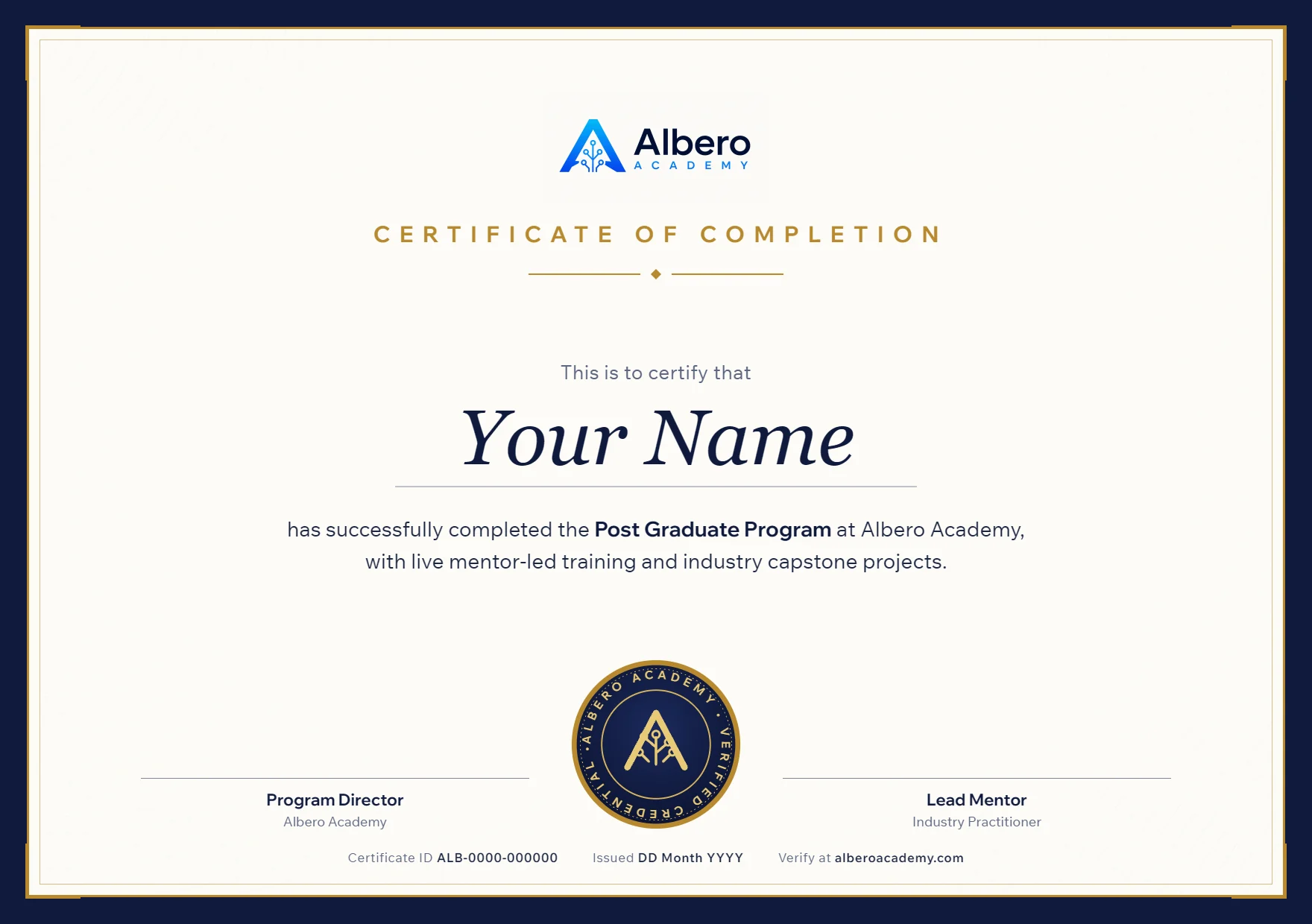
Albero Academy certificate of completion, awarded on completing the PGP in Data Science & AI Engineering
  • Certification partner
  • Certification partner
  • Microsoft AI-900

    Microsoft AI-900

    Voucher included

    Azure AI Fundamentals, exam voucher included.

  • IBM AI Engineering

    IBM AI Engineering

    Stack badge across PyTorch, TensorFlow, and ML deployment.

  • NSDC Skill Certification

    Government-recognised certificate of completion.

Fees and plans.

Pick the support you want. Hold a seat with ₹5,000 and pay the rest later, or pay in full. Next batch: 5 Dec 2026.

  1. Self-Paced

    ₹55,000

    or ₹5,500/mo on EMI

    • Lifetime access
    • Recorded sessions
    • Community support

    Reserving takes ₹5,000 + GST, non-refundable and counted towards the fee.

  2. Mentor-Led

    Recommended

    ₹95,000

    or ₹9,500/mo on EMI

    • Live classes
    • 1:1 mentorship
    • Capstone reviews
    • Mock interviews

    Reserving takes ₹5,000 + GST, non-refundable and counted towards the fee.

  3. Career Pro

    ₹1,35,000

    or ₹13,500/mo on EMI

    • Everything in Mentor-Led
    • Cloud + GPU credits
    • Hiring partner access
    • Dedicated career coach

    Reserving takes ₹5,000 + GST, non-refundable and counted towards the fee.

Frequently asked questions.

  • No. Every program has a "Foundations" sprint at the start that brings non-coders up to speed before the core curriculum begins.

  • Live mentor sessions, code reviews on every assignment, and real placement support. You are accountable to a cohort and a coach, not a video.

  • Every session is recorded and posted within 24 hours. Mentors host weekly catch-up office hours so you never fall behind.

  • Yes. You can split the fee into 3, 6, 9 or 12-month EMIs with our partner lenders. Your counsellor walks you through the options.

  • Our placement support continues until you land an offer at or above the program-target salary. Specific terms are detailed on the offer letter.

  • Yes. Within the first 14 days you can switch to any other program for free. After that, switching is allowed once per cohort with a small admin fee.

Ready to start your journey?

Talk to a counsellor today. We’ll help you pick the right plan, batch, and learning path for your goals.

Next batch starts

5 Dec 2026

A new batch starts in every program, every month.