




CloudProduct team40 deploys a day
End-to-end CI/CD pipeline
A GitOps pipeline with automated tests, canary deploys and one-click rollbacks.
 Docker
 GitHub Actions
 Argo CD
Lead time for changes under 15 minutes2 weeks
Automate, containerize & scale infrastructure across every major cloud
A 9-month advanced track in DevOps and Cloud Engineering. Master Linux, Docker, Kubernetes, Terraform and CI/CD across AWS, Azure and GCP, with observability via Prometheus — the exact stack that powers reliable, scalable platforms at top tech companies.
Next batch: 5 Dec 2026
Quick 15-min call: get program details, eligibility, and fee structure.
Every logo represents a real placement, not a paid sponsorship. Our alumni are powering AI, data, and analytics teams at companies you already admire.
Software delivery is now continuous, cloud is the default substrate, and reliability is a competitive feature. These structural shifts created a permanent, high-demand discipline (DevOps/Cloud/SRE) that sits at the operational center of how modern companies compete. It’s consistently among the hardest roles to fill.
Who it’s for
From fresh graduates to working professionals, our learners have moved into high-paying roles at top companies through structured mentorship, real projects and placement-driven training.
What you actually get when you sign up, beyond the lecture videos.
1:1 reviews + weekly group sessions with practitioners hiring at MAANG.

Build the exact deliverables hiring managers ask about in interviews.
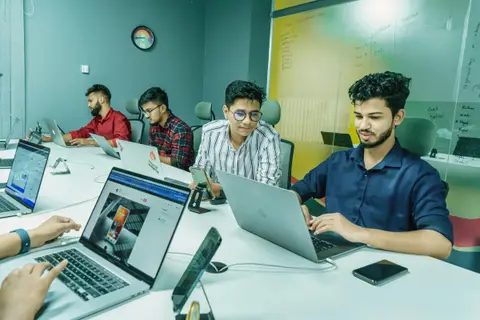
Mock interviews, resume + LinkedIn craft, direct referrals to 650+ partners.
Tools, concepts, and the soft skills that round out the package.
 Linux
 GitGitHub ActionsDocker
 Kubernetes
 Helm
 Terraform
 AnsibleArgo CD
 AWS
 Azure
 Google Cloud
 Prometheus
 Grafana
 GitHub Copilot
15 tools you’ll touch, and many more reviewed in 1:1 mentor sessions.
Master AI, Data Science, Full Stack Development, CyberSecurity, Data Engineering, and Finance through live mentor-led programs designed around real industry expectations and high-growth career outcomes.
PGP
Your stack
5 tools, one cohesive lab
Train on modern tools, workflows, and technologies inspired by the ecosystems used at Microsoft, IBM, Cisco, J.P. Morgan, and other global leaders.
Build portfolio-grade projects, solve practical business problems, and gain hands-on exposure that prepares you for actual interviews and job environments.
Get dedicated mentorship, resume building, mock interviews, placement assistance, and career guidance designed to help you secure high-paying opportunities.
Train with industry-grade technologies, build real-world projects, and gain hands-on experience through mentor-led programs designed around modern hiring standards.15 industry-grade tools powering real-world career outcomes
Capstones built on real datasets and real briefs, graded on craft, not completion.
A GitOps pipeline with automated tests, canary deploys and one-click rollbacks.
DockerGitHub ActionsArgo CD
Run a production-grade cluster with Helm, autoscaling, network policies and Prometheus monitoring.
KubernetesHelmPrometheus
Provision hardened, policy-checked infrastructure across two clouds from a single Terraform codebase.
TerraformAWSAzure
Move a legacy monolith into containers with a blue/green cut-over, data migration and a tested rollback path.
DockerKubernetesArgo CD
Instrument a platform end-to-end, define SLOs, wire alerting and run a game-day incident with a postmortem.
PrometheusGrafanaLinux
Serve an open LLM on GPU nodes with autoscaling, request batching and a cost dashboard.
KubernetesGoogle CloudDockerSame problems hiring managers ask about in interviews. We walk every step with you.


Big Tech
Outcome
−85% drift incidents
Problem
Infra drift across environments caused hard-to-reproduce production incidents.
Approach
Codified everything in Terraform with policy-as-code gates and a single promotion pipeline.
Result
Environments became reproducible from a single source of truth.

Outcome
MTTR 4h → 18m
Problem
Mean-time-to-recovery on the platform was measured in hours.
Approach
Added Prometheus + Grafana SLOs, automated runbooks, and progressive delivery.
Result
With alerting tuned to cut pager noise by half.
Industry-validated, practice-first, mentor-reviewed every batch.
Everything runs on Linux. Shell, scripting, services and enough networking to debug what breaks between machines.
What you’ll cover
Linux essentials
file system, permissions, users, processes and package managers
Bash scripting
variables, loops, functions and automating server set-up
Services
systemd units, logs with journalctl and scheduled jobs with cron
Networking fundamentals
TCP/IP, ports, DNS, HTTP and TLS
Troubleshooting
curl, dig, ss, traceroute and tcpdump for broken connections
Security hardening
SSH keys, firewalls, fail2ban and least-privilege users
Git for operations
version-controlling scripts and configuration
Tools you’ll use
LinuxGitAI in this module
Use an AI assistant to explain unfamiliar commands and draft scripts, and run them in a sandbox before any real server.
Module project
Hardened Linux server with automated setup scripts
You’ll be able to
Package anything reproducibly: images, layers, Compose stacks and registries.
What you’ll cover
Container fundamentals
images, layers, containers and how they differ from VMs
Writing Dockerfiles
multi-stage builds, caching and small, secure images
Networking & volumes
container networks, ports and persistent data
Docker Compose
multi-service stacks for local development and testing
Registries
tagging, pushing and pulling from Docker Hub and cloud registries
Image security
scanning for vulnerabilities and running as non-root
Debugging containers
logs, exec, inspect and resource limits
Tools you’ll use
DockerLinuxAI in this module
Have AI review your Dockerfiles for size and security, then confirm each suggestion with an image scan.
Module project
Multi-service app on Docker Compose
You’ll be able to
The platform every cloud team runs on: workloads, networking, ingress and Helm packaging.
What you’ll cover
Kubernetes architecture
control plane, nodes, kubelet and the API server
Workloads
pods, deployments, replica sets, jobs and stateful sets
Networking
services, ingress controllers and DNS inside the cluster
Configuration
ConfigMaps, Secrets and environment-specific settings
Scaling & resilience
resource requests, autoscaling, probes and rolling updates
Storage
persistent volumes and claims for stateful apps
Helm
packaging, templating and releasing applications
Tools you’ll use
KubernetesHelmDockerAI in this module
Generate manifests and Helm charts with AI, then validate them with dry runs and policy checks before applying.
Module project
Production-grade Kubernetes deployment with Helm
You’ll be able to
Provision infrastructure from version-controlled Terraform, with state management that survives a team.
What you’ll cover
Why IaC
reproducibility, review and drift in hand-built infrastructure
Terraform basics
providers, resources, variables and outputs
State management
remote state, locking and safe team workflows
Modules
reusable, versioned building blocks for networks and services
Environments
workspaces and directory layouts for dev, staging and prod
Configuration management
Ansible playbooks for server configuration
Policy & security
scanning Terraform plans before they apply
Tools you’ll use
TerraformAnsibleAWSAI in this module
Use Copilot to write Terraform modules, and review every plan diff yourself before anything is applied.
Module project
Reusable Terraform modules for a three-tier app
You’ll be able to
AWS in depth, Azure and GCP essentials — enough to be productive on whichever cloud your employer runs.
What you’ll cover
AWS core
IAM, VPC, EC2, S3, RDS and load balancers in depth
Serverless on AWS
Lambda, API Gateway and event-driven design
Managed Kubernetes
EKS, AKS and GKE compared
Azure essentials
resource groups, App Service, VNets and Entra ID
Google Cloud fundamentals
projects, Compute Engine, Cloud Run and IAM
High availability
multi-AZ design, backups and disaster recovery
Cost awareness
pricing models, tagging, budgets and right-sizing
Tools you’ll use
AWSAzureGoogle CloudAI in this module
Ask an LLM to compare equivalent services across clouds, then verify the details against each provider’s documentation.
Module project
The same workload deployed to AWS and Azure
You’ll be able to
Pipeline design, GitOps and automated testing, so releases are boring.
What you’ll cover
Pipeline design
stages, artefacts, caching and fast feedback
GitHub Actions
workflows, matrices, secrets and reusable actions
Automated testing
unit, integration and smoke tests as quality gates
Release strategies
blue-green, canary and feature flags
GitOps with Argo CD
Git as the source of truth for cluster state
Supply-chain security
dependency scanning, image signing and SBOMs
Rollbacks
making failed releases fast and boring to undo
Tools you’ll use
GitHub ActionsArgo CDKubernetesAI in this module
Use AI to draft workflows and diagnose failed runs from their logs, and keep humans approving production releases.
Module project
GitOps pipeline with canary deploys and rollbacks
You’ll be able to
Metrics, dashboards, alerting and incident response — the SRE practices that keep systems up.
What you’ll cover
Observability
metrics, logs and traces, and what each one answers
Prometheus
exporters, PromQL and recording rules
Grafana
dashboards that show service health at a glance
SLIs, SLOs & error budgets
defining reliability in numbers
Alerting
actionable alerts, routing and avoiding alert fatigue
Incident response
on-call, runbooks, severity levels and communication
Postmortems
blameless reviews and fixes that prevent a repeat
Tools you’ll use
PrometheusGrafanaKubernetesAI in this module
Use AI to summarise noisy logs and draft postmortems, while root-cause conclusions come from the evidence you gather.
Module project
Observability stack with SLOs and on-call runbooks
You’ll be able to
Build a complete platform end-to-end, write the on-call playbook, and prepare for DevOps interviews with mentors from Microsoft.
What you’ll cover
Platform capstone
infrastructure, cluster, pipelines and monitoring built from scratch
On-call playbook
runbooks and a simulated incident you lead
Architecture write-up
diagrams, decisions and cost estimate
Certification guidance
preparing for AWS, Kubernetes and Terraform exams
DevOps interview prep
Linux, networking, Kubernetes and scenario questions
Mock interviews
practical troubleshooting rounds with mentors
Tools you’ll use
TerraformKubernetesGitHub ActionsGrafanaAI in this module
Your platform includes AI-assisted operations, such as log summaries and alert triage, with clear human approval steps.
Module project
End-to-end platform build with an on-call playbook
You’ll be able to
Engineers and leaders from the companies you want to work at, mentoring you live, every week.
A deliberate, milestone-gated path from foundations to an offer.
Month 1–3
Linux, networking, Git, Bash, Docker
By the end
Administer and harden Linux, script in Bash, and containerise any application.
Month 4–6
Kubernetes, Helm, Terraform, Ansible, CI/CD
By the end
Run workloads on Kubernetes and provision infrastructure as code behind a full CI/CD pipeline.
Month 7–9
AWS/Azure/GCP, Prometheus, Grafana, OpenTelemetry, AIOps + capstone
By the end
Operate multi-cloud systems with SLOs, dashboards, alerting and automated recovery.
Offer & placement support until you sign.
Realistic salary ranges from market data, not optimistic averages.
Who hires
 Flipkart
 Razorpay
 PhonePe
Who hires
Microsoft Amazon
 Accenture
Who hires
 Uber
 Walmart Labs
 Adobe
Bars share one scale, from 0 to ₹30 L a year, so the roles compare at a glance.
Indicative India bands, 2025–26. SRE and cloud-architect tracks anchor the upper ranges.
Figures in ₹ lakh per annum. A band ending in “+” has no fixed ceiling.
CKA-style and SRE questions you’ll be ready for:
Mock interview, recorded
4
sample questions. Many more in the mock loops.
Mentor feedback
Strong answer. Now walk me through the trade-off.
Model answer
A VM virtualizes hardware and runs a full guest OS; a container virtualizes the OS and shares the host kernel: lighter and faster, with weaker isolation.
Model answer
SLIs are measured indicators (latency/availability), SLOs are their target thresholds, and the error budget is the allowed unreliability; when exhausted, you prioritize reliability over features.
Model answer
Check describe + previous logs, verify config/secrets, resource limits, liveness/readiness probes, the image, and dependencies; reproduce locally if needed.
Model answer
It makes infrastructure versioned, reviewable, repeatable, and auditable, eliminating manual drift and enabling reproducible environments.
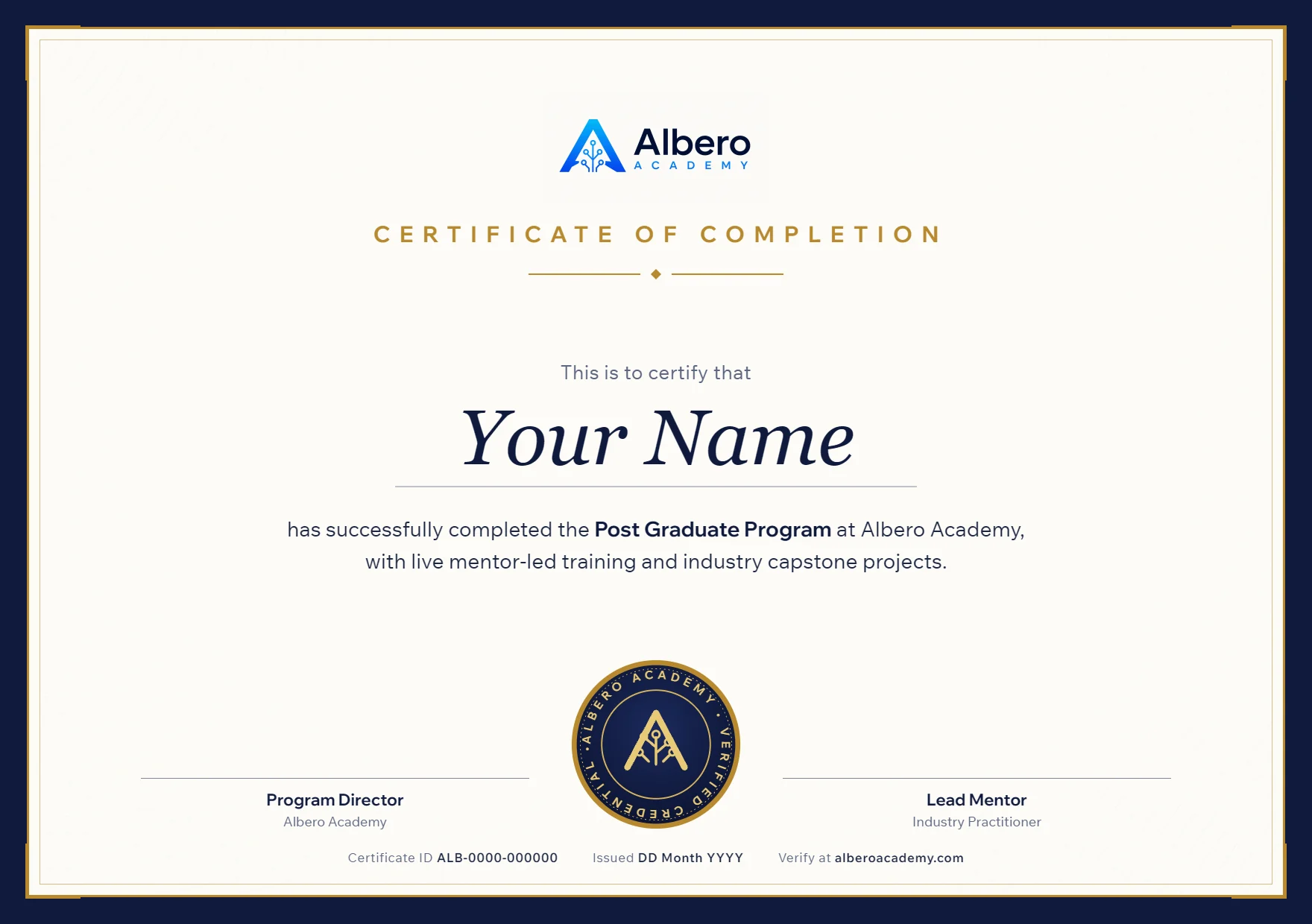
Stack badges that signal credibility: AWS, Azure, CKA, plus the Albero Academy certificate.

SAA-C03, exam voucher included.
Microsoft Azure Administrator, exam voucher included.
Certified Kubernetes Administrator, exam voucher included.
Pick the support you want. Hold a seat with ₹5,000 and pay the rest later, or pay in full. Next batch: 5 Dec 2026.
₹55,000
or ₹5,500/mo on EMI
Reserving takes ₹5,000 + GST, non-refundable and counted towards the fee.
₹95,000
or ₹9,500/mo on EMI
Reserving takes ₹5,000 + GST, non-refundable and counted towards the fee.
₹1,35,000
or ₹13,500/mo on EMI
Reserving takes ₹5,000 + GST, non-refundable and counted towards the fee.
No. Every program has a "Foundations" sprint at the start that brings non-coders up to speed before the core curriculum begins.
Live mentor sessions, code reviews on every assignment, and real placement support. You are accountable to a cohort and a coach, not a video.
Every session is recorded and posted within 24 hours. Mentors host weekly catch-up office hours so you never fall behind.
Yes. You can split the fee into 3, 6, 9 or 12-month EMIs with our partner lenders. Your counsellor walks you through the options.
Our placement support continues until you land an offer at or above the program-target salary. Specific terms are detailed on the offer letter.
Yes. Within the first 14 days you can switch to any other program for free. After that, switching is allowed once per cohort with a small admin fee.
Talk to a counsellor today. We’ll help you pick the right plan, batch, and learning path for your goals.
Next batch starts
5 Dec 2026
A new batch starts in every program, every month.