


WebMarketplaceBig-Billion-Day load
Scalable e-commerce backend
A sharded, cache-backed order and inventory service that stays consistent under flash-sale traffic.
 Java
 Spring Boot
 PostgreSQL
 Redis
10K orders/min with zero oversells3 weeks
The elite 12-month track to a product-company SDE role
A 12-month elite engineering track that builds true software depth — DSA, system design, and a modern Java + JavaScript/TypeScript stack across React, Next.js and Node on AWS. Designed to clear product-company interviews and land SDE-1, Backend and Frontend Engineer offers.
Next batch: 5 Dec 2026
Quick 15-min call: get program details, eligibility, and fee structure.
Every logo represents a real placement, not a paid sponsorship. Our alumni are powering AI, data, and analytics teams at companies you already admire.
Every company is a software company now. The gap between “can write code” and “can clear a top product-company loop” is DSA + system design + production engineering, and that gap is exactly what this 12-month elite track is built to close.
Who it’s for
From fresh graduates to working professionals, our learners have moved into high-paying roles at top companies through structured mentorship, real projects and placement-driven training.
What you actually get when you sign up, beyond the lecture videos.
1:1 reviews + weekly group sessions with practitioners hiring at MAANG.

Build the exact deliverables hiring managers ask about in interviews.

Mock interviews, resume + LinkedIn craft, direct referrals to 650+ partners.

Tools, concepts, and the soft skills that round out the package.
JavaSpring Boot JavaScript
 TypeScript
 React
 Node.jsPostgreSQLRedis
 Git
 GitHub
 Docker
 AWS
 GitHub Copilot
 Cursor
14 tools you’ll touch, and many more reviewed in 1:1 mentor sessions.
Master AI, Data Science, Full Stack Development, CyberSecurity, Data Engineering, and Finance through live mentor-led programs designed around real industry expectations and high-growth career outcomes.
PGP
Your stack
5 tools, one cohesive lab
Train on modern tools, workflows, and technologies inspired by the ecosystems used at Microsoft, IBM, Cisco, J.P. Morgan, and other global leaders.
Build portfolio-grade projects, solve practical business problems, and gain hands-on exposure that prepares you for actual interviews and job environments.
Get dedicated mentorship, resume building, mock interviews, placement assistance, and career guidance designed to help you secure high-paying opportunities.
Train with industry-grade technologies, build real-world projects, and gain hands-on experience through mentor-led programs designed around modern hiring standards.14 industry-grade tools powering real-world career outcomes
Capstones built on real datasets and real briefs, graded on craft, not completion.
A sharded, cache-backed order and inventory service that stays consistent under flash-sale traffic.
JavaSpring BootPostgreSQLRedis
Horizontally-scaled WebSocket fan-out with presence, delivery receipts and offline queueing.
Node.jsReact KafkaRedis

Match riders to nearby drivers with a geospatial index, surge pricing and idempotent booking.
JavaRedisPostgreSQL
A double-entry ledger with idempotency keys, retries and reconciliation: the core of every fintech interview.
Spring BootPostgreSQLKafka
A GitHub App that reviews pull requests with an LLM, enforces team conventions and posts inline suggestions.
TypeScript OpenAIGitHub

Architect, document and deploy a multi-service platform with autoscaling, observability and a written HLD/LLD.
AWSDocker Kubernetes
Same problems hiring managers ask about in interviews. We walk every step with you.


Big Tech
Outcome
6× throughput
Problem
Checkout service buckled under festival-sale traffic spikes.
Approach
Re-architected to event-driven services with read-replicas + a Redis write-through cache.
Result
p99 latency held under 120ms at peak load.

Consumer
Outcome
−70% rollbacks
Problem
Monolithic order pipeline made every release a multi-team risk.
Approach
Decomposed into bounded-context microservices with contract tests + canary deploys.
Result
Release cadence moved from weekly to multiple times a day.
Industry-validated, practice-first, mentor-reviewed every batch.
Pattern-based DSA, the way top companies test it. 200+ curated problems with weekly contests — not random grinding.
What you’ll cover
Complexity analysis
Big-O for time and space, amortised cost and reading constraints
Arrays & strings
two pointers, sliding window and prefix sums
Hashing
hash maps and sets for counting, grouping and O(1) lookups
Linked lists, stacks & queues
monotonic stacks and the classic pointer problems
Trees & BSTs
traversals, recursion patterns and lowest common ancestor
Graphs
BFS, DFS, topological sort, Dijkstra and union-find
Dynamic programming
memoisation to tabulation across 1D, 2D and knapsack patterns
Weekly contests
timed problem sets that build speed and a rated track record
Tools you’ll use
Java PythonGit
AI in this module
Use AI only after an honest attempt: ask for a hint, not a solution, then explain the final approach out loud as you would in an interview.
Module project
200+ problems solved and a rated contest
You’ll be able to
The backbone of Indian enterprise engineering. Object-oriented design, collections, concurrency and what the JVM is really doing.
What you’ll cover
Java fundamentals
types, control flow, strings and the standard library
Object-oriented design
encapsulation, inheritance, interfaces and composition over inheritance
Collections framework
List, Set, Map implementations and their complexity trade-offs
Generics & functional Java
lambdas, streams and Optional
Exceptions & testing
checked vs unchecked exceptions, JUnit 5 and Mockito
Concurrency
threads, executors, locks, CompletableFuture and avoiding race conditions
JVM internals
memory model, garbage collectors and reading GC logs
Design patterns
factory, builder, strategy and observer in real code
Tools you’ll use
JavaGitGitHub CopilotAI in this module
Use Copilot to generate unit-test cases, then add the edge cases it missed: nulls, concurrency and overflow.
Module project
Multi-threaded order-matching engine
You’ll be able to
Modern JavaScript as a first-class language, then TypeScript's type system so large codebases stay safe.
What you’ll cover
Modern JavaScript
ES modules, destructuring, spread and the language features you will use daily
Scope & closures
how functions capture state, and the bugs that follow
The event loop
call stack, microtasks and macrotasks, explained with real traces
Async patterns
promises, async/await, cancellation and error handling
TypeScript foundations
types, interfaces, unions and strict mode
Advanced types
generics, mapped and conditional types for safe large codebases
Tooling
npm, bundlers, ESLint, Prettier and testing with Vitest
Tools you’ll use
JavaScriptTypeScriptGitAI in this module
Use Cursor to migrate a JavaScript module to strict TypeScript, and review each inferred type rather than accepting any.
Module project
Typed SDK for a public API
You’ll be able to
Build interfaces the way product companies do: composable components, server rendering, and measurable performance.
What you’ll cover
React fundamentals
components, props, state and one-way data flow
Hooks in depth
useState, useEffect, useMemo, useRef and writing custom hooks
State management
context, reducers and a server-state library for data fetching
Next.js App Router
layouts, server components, SSR, SSG and streaming
Forms & validation
controlled inputs, schema validation and accessible errors
Performance
profiling renders, code splitting and Core Web Vitals
Testing UIs
React Testing Library and end-to-end tests with Playwright
Accessibility
semantic HTML, focus management and keyboard support
Tools you’ll use
React Next.jsTypeScript
 Vercel
AI in this module
Generate component scaffolds with AI, then own the accessibility and performance pass yourself, measured in Lighthouse.
Module project
SSR storefront scoring 95+ on Lighthouse
You’ll be able to
APIs that survive real traffic, in the two stacks Indian product and enterprise teams hire for: Spring Boot and Node, with authentication, validation and Redis caching.
What you’ll cover
Spring Boot essentials
REST controllers, dependency injection and configuration
Persistence with JPA
entities, repositories, transactions and the N+1 query problem
Node.js services
Express routing, middleware and structured error handling
API design
REST conventions, versioning, pagination and GraphQL for complex reads
Authentication
sessions vs JWT, OAuth 2.0 and role-based access control
Validation & security
input validation, rate limiting and the OWASP API risks
Caching with Redis
cache-aside, TTLs and invalidation without stale data
Testing APIs
integration tests, Postman collections and contract tests
Tools you’ll use
Spring BootNode.jsPostgreSQLRedisAI in this module
Use an AI assistant to draft API handlers and tests, and threat-model each endpoint yourself before it merges.
Module project
Auth-secured API with Redis caching
You’ll be able to
High- and low-level design for interviews and for the job: scalability patterns, data stores, queues and the trade-offs behind each.
What you’ll cover
Design fundamentals
requirements, capacity estimates and back-of-envelope maths
Scalability patterns
load balancing, horizontal scaling and stateless services
Databases
SQL vs NoSQL, indexing, replication, sharding and partitioning
Caching layers
CDN, application and database caches and their failure modes
Messaging
queues and event streams with Kafka, idempotency and retries
Consistency & reliability
CAP, eventual consistency, timeouts and circuit breakers
Low-level design
classes, interfaces and patterns for parking lots, LRU caches and more
Case studies
URL shortener, news feed, chat and payment systems
Tools you’ll use
PostgreSQLRedisDockerAI in this module
Critique your design with an LLM acting as a sceptical senior engineer, then defend or revise each trade-off.
Module project
Two system-design documents reviewed by senior engineers
You’ll be able to
Ship what you build. Core AWS services, CI/CD pipelines and observability so you can own a service end-to-end.
What you’ll cover
AWS foundations
regions, accounts, IAM users, roles and least privilege
Compute
EC2, auto-scaling groups and Lambda for event-driven work
Storage & data
S3, RDS and DynamoDB, and when to use each
Networking
VPCs, subnets, security groups and load balancers
Containers on AWS
Docker images, ECR and ECS deployments
CI/CD
GitHub Actions pipelines that test, build and deploy on every merge
Observability
CloudWatch logs, metrics, alarms and tracing a slow request
Tools you’ll use
AWSDocker GitHub Actions
AI in this module
Draft infrastructure and pipeline configs with Copilot, and check every IAM policy it writes for over-broad permissions.
Module project
Microservice deployed on AWS with a CI/CD pipeline
You’ll be able to
Weekly DSA and system-design mocks with engineers from Google and Atlassian, plus behavioural rounds and offer negotiation.
What you’ll cover
Production capstone
a deployed, tested service with documentation and a design doc
DSA mock rounds
timed problems with engineers from product companies
System-design mocks
whiteboard sessions scored against a rubric
Behavioural rounds
STAR stories for ownership, conflict and failure
Resume & GitHub review
showing impact, not just technologies
Offer strategy
comparing offers, negotiation and joining well
Tools you’ll use
JavaReactAWSGitAI in this module
Practise with AI mock interviewers between live mocks, and review your recorded answers for clarity and structure.
Module project
Production-scale capstone and a mock-interview scorecard
You’ll be able to
Engineers and leaders from the companies you want to work at, mentoring you live, every week.
A deliberate, milestone-gated path from foundations to an offer.

Month 1–3
Java/Python/JS, complexity, pattern-based DSA
By the end
Solve pattern-based DSA problems under time pressure in Java, JavaScript or Python.
Month 4–6
TypeScript, Node/Express, React/Next.js, databases, Redis
By the end
Build and ship a typed full-stack app with auth, a relational database and a cache layer.
Month 7–9
Kafka, Docker, Kubernetes, AWS, CI/CD, LLD + HLD
By the end
Reason about distributed systems, deploy microservices on Kubernetes, and write LLD/HLD documents.

Month 10–12
Advanced DSA, system-design drills, capstone, mock loops
By the end
Clear FAANG-style DSA and system-design loops with a track record of mock interviews behind you.
Offer & placement support until you sign.
Realistic salary ranges from market data, not optimistic averages.

Who hires
Flipkart MicrosoftAmazon
Who hires
 Razorpay
 Atlassian
 PhonePe

Who hires
 CRED
 Zomato
 Adobe
Bars share one scale, from 0 to ₹40 L a year, so the roles compare at a glance.
Indicative India bands, 2025–26. Top product companies and GCCs anchor the upper ranges.
Figures in ₹ lakh per annum. A band ending in “+” has no fixed ceiling.
Months 10–12 are intensive mock loops. A sample of what you’ll clear:
Mock interview, recorded
4
sample questions. Many more in the mock loops.
Mentor feedback
Strong answer. Now walk me through the trade-off.
Model answer
API + key-generation (base62 of a counter or hash), a short→long store, Redis caching for hot reads, and a redirect service. Scale reads with caching/replication; handle collisions and async analytics.
Model answer
During a network partition you must choose Consistency or Availability; you can’t have all three simultaneously. The choice depends on the use case.
Model answer
Track current = max(num, current+num) and best = max(best, current). O(n) time, O(1) space.
Model answer
SQL for structured data, strong consistency, complex joins/transactions; NoSQL for flexible schemas, high write throughput, and horizontal scale.
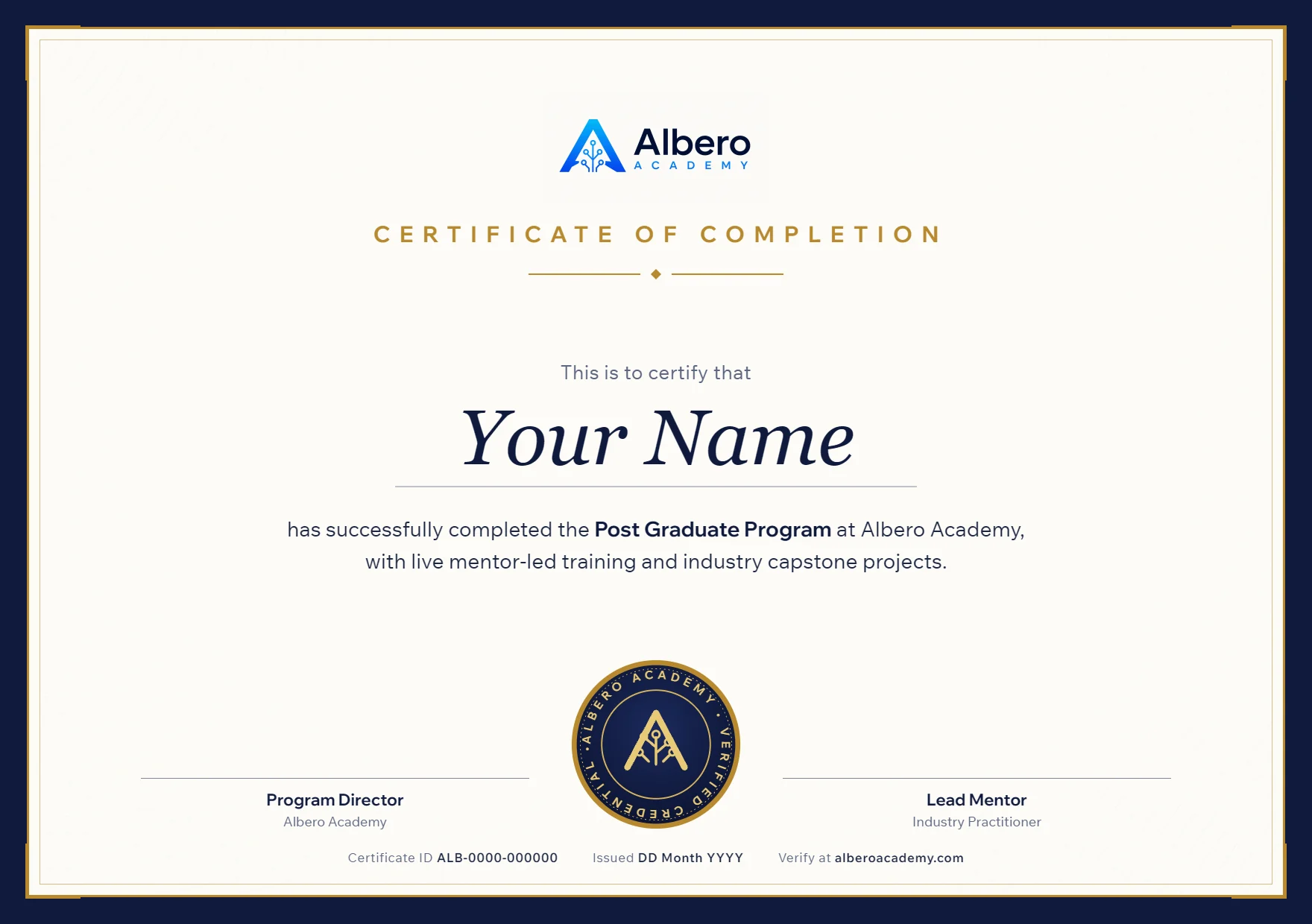
Stack badges that signal credibility: AWS, Oracle, CKA, plus the Albero Academy certificate.


Developing on AWS, exam voucher included.
Java SE programmer certification, exam voucher.
Certified Kubernetes Administrator, exam voucher included.
Pick the support you want. Hold a seat with ₹5,000 and pay the rest later, or pay in full. Next batch: 5 Dec 2026.
₹75,000
or ₹7,500/mo on EMI
Reserving takes ₹5,000 + GST, non-refundable and counted towards the fee.
₹1,25,000
or ₹12,500/mo on EMI
Reserving takes ₹5,000 + GST, non-refundable and counted towards the fee.
₹1,75,000
or ₹17,500/mo on EMI
Reserving takes ₹5,000 + GST, non-refundable and counted towards the fee.
No. Every program has a "Foundations" sprint at the start that brings non-coders up to speed before the core curriculum begins.
Live mentor sessions, code reviews on every assignment, and real placement support. You are accountable to a cohort and a coach, not a video.
Every session is recorded and posted within 24 hours. Mentors host weekly catch-up office hours so you never fall behind.
Yes. You can split the fee into 3, 6, 9 or 12-month EMIs with our partner lenders. Your counsellor walks you through the options.
Our placement support continues until you land an offer at or above the program-target salary. Specific terms are detailed on the offer letter.
Yes. Within the first 14 days you can switch to any other program for free. After that, switching is allowed once per cohort with a small admin fee.
Talk to a counsellor today. We’ll help you pick the right plan, batch, and learning path for your goals.
Next batch starts
5 Dec 2026
A new batch starts in every program, every month.